


Structural Health Monitoring using Acoustic Emission
TISEC offers acoustic emission (AE) based steel bridge structural health monitoring services. It may be deployed remotely for hours or months depending on the application. For longer monitoring periods, the client can login through a secure on-line connection to observe real-time inspection results.
SABRE™ Bridge Inspection and Monitoring
SABRE™ and SIM-o-IP™ are the bases for the SABRE™ system for continuous monitoring of bridges.
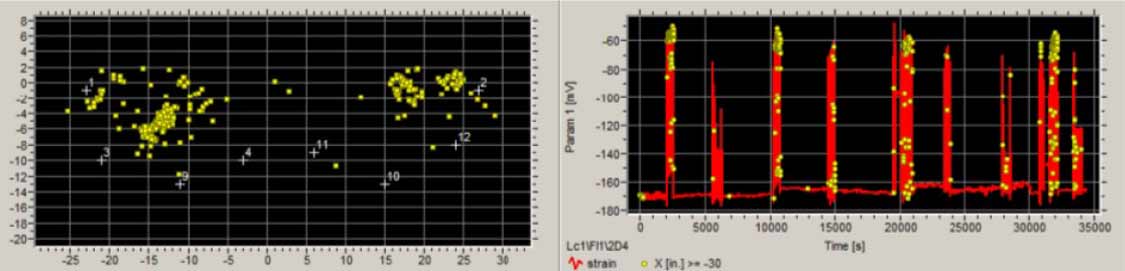
SABRE™ is a system for acoustic emission monitoring of bridge members. It is used in a PC-based configuration for periodic monitoring. Its SABRE™ unit is used for low-cost wireless long-term monitoring and the results are used with SIM-o-IP™ for data communication and interpretation. SIM-o-IP™ had its first deployment in 2012 on the Jacques Cartier Bridge and a private railway bridge in the Gaspe.
Sensors are rapidly deployed on target structures.
Bridge configurations most often monitored include:
- Hanger connections
- Link pin connection
- Copes and stringers
- Stiffener to weld connections
- Web Stiffeners
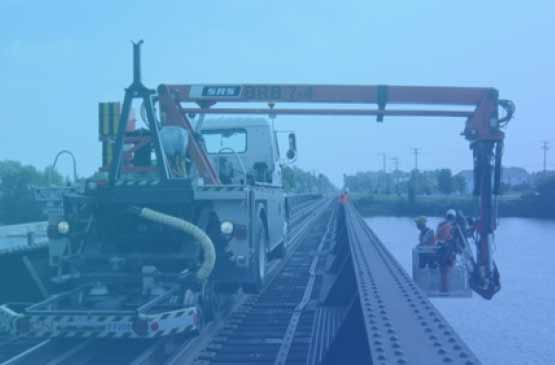
The vast majority of steel bridges currently in use are:
Well beyond their original design life, loaded significantly above their original design values and experiencing premature structural problems from component fatigue.
Safely extending the life while maximizing load ratings of such railway bridges, and maintaining ongoing, uninterrupted traffic operations, are great economic benefits to the bridge owner. Achieving such goals depends to a large extent on developing and maintaining an effective bridge inspection program.
Active, or growing, flaws in safety-critical structures emit acoustic emission (AE) under load while dormant flaws do not emit AE. The active flaws are ranked according to activity and intensity and a Fatigue Crack Index (FCI) – between the range of 1 and 5 – is generated. An FCI 0 recommends maintaining normal maintenance practices. An FCI 5 recommends immediate operations control and maintenance assessment.
Economic Impact of Continuous AE Monitoring
In a case study of a 1000-foot long open deck bridge built in 1910 with roughly 33 million gross tons of annual traffic, which is approximately a 115% increase since its construction, cracks were observed at the bottom of intermediate stiffeners where they connect to the transverse brace frames. The replacement of these spans, estimated at approximately $10 M appeared to be the inevitable recourse. AE monitoring carried out by TISEC assessed the crack activity levels of critical areas. It was possible to delay replacement and adopt a manageable risk strategy to maintain existing and projected levels of safe train operations.
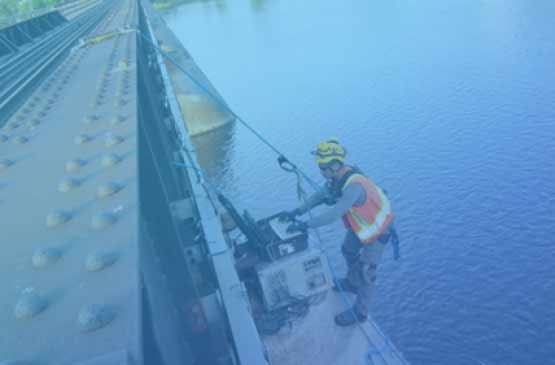
Our American Society for Nondestructive Testing (ASNT) certified inspectors have complementary training in fall protection, highway safety, railway safety, and confined space safety. With over 300 bridges tested to date, we have a proven track record for high quality nondestructive testing services and safety.